A transformative shift is underway in the Arabic audio content space across the UAE and Gulf region. A format that was until recently dominated almost entirely by English-language shows from international producers is being reclaimed and reshaped by Arabic-speaking creators who understand their audience in ways that no imported content ever could.
Arabic podcasts in the UAE are growing at a rate that the regional media landscape has not seen in years. New shows are launching every month. Existing shows are building audiences of hundreds of thousands of listeners across the Gulf. Brands are beginning to take Arabic podcast sponsorship seriously as a genuine marketing channel. And the creators at the forefront of this movement are building something that goes well beyond content they are building cultural touchstones for a generation of Arabic speakers who have been underserved by mainstream media.
If you are thinking about launching an Arabic podcast in the UAE, here is everything you need to know from the state of the market today to the specific decisions that will determine whether your show grows or stagnates.
The Current State of Arabic Podcasting in the UAE
The Arabic podcast audience in the Gulf is large, growing fast, and dramatically underserved. Spotify’s data for the MENA region shows consistent year-on-year growth in Arabic podcast consumption, with the UAE and Saudi Arabia leading in both listener numbers and engagement rates. The demographic profile of Arabic podcast listeners in the UAE skews toward educated, urban professionals aged 25 to 45 exactly the audience brands most want to reach and that advertisers pay the most to access.
Despite this, the supply of high-quality Arabic podcast content remains significantly lower than demand. The gap between the number of Arabic speakers seeking high-quality podcast content and the number of shows actually producing it is enormous compared to equivalent gaps in the English, Spanish, or Mandarin markets. This is not a problem it is a wide-open opportunity. The first creators who build quality Arabic shows in specific niches and maintain consistent output will own those niches for years.
Understanding the Arabic Podcast Audience in the UAE
Arabic-speaking audiences in the UAE are not a single group. The country’s Arab population includes Emirati nationals alongside large communities from Egypt, Lebanon, Jordan, Syria, Palestine, Morocco, Sudan, Iraq, and across the wider Arab world all speaking Arabic but with significantly different dialects, cultural references, humour, and content preferences.
The dialect question is one of the most important decisions an Arabic podcast creator in Dubai has to make before recording a single episode.
Gulf dialect particularly Emirati and Saudi resonates most strongly with local and Gulf audiences and carries a certain regional prestige. Egyptian dialect has the widest reach across the Arab world because of Egypt’s long dominance in Arab media and entertainment an Egyptian-dialect show is understood comfortably everywhere from Morocco to Oman. Levantine dialect the varieties spoken in Lebanon, Syria, Jordan, and Palestine carries associations of sophistication, wit, and creative depth that appeal strongly to urban professional audiences. Modern Standard Arabic creates a formal, authoritative register that works well for news and educational content but can feel stiff and distant in conversational or entertainment formats.
Most successful Arabic podcasts in the UAE choose one primary dialect and stay consistent with it, while keeping the vocabulary and cultural references broad enough for listeners across the Arab world.
The Topics That Are Building Audiences Fast
Business and Entrepreneurship
This is the fastest-growing category in Arabic podcasting in the UAE. The Gulf’s entrepreneurial culture is vibrant, and the appetite for practical, honest content on building businesses, navigating the UAE’s commercial environment, and managing careers delivered in Arabic by people with real regional experience is enormous. Shows featuring real founders, real investors, and genuine stories of success and failure are building large loyal audiences quickly. The key differentiator is honesty Arabic business podcast audiences are particularly responsive to creators who speak directly and candidly rather than presenting a sanitised version of the entrepreneurial journey.
Personal Finance and Investment
Financial literacy content in Arabic is one of the most dramatically underserved categories in the UAE media landscape. The specific complexity of managing finances in a country with no income tax, multiple currencies in daily use, a large proportion of residents planning eventual return to their home countries, and a real estate market unlike anywhere else in the world creates a very specific set of financial questions that no English-language podcast adequately addresses. An Arabic podcast that speaks directly to this audience with relevant, practical, culturally informed financial content has an enormous potential audience and a strong commercial profile, making sponsorship straightforward to attract.
Mental Health and Personal Wellbeing
Arabic-language mental health content is one of the most significant gaps in the regional media landscape. Cultural factors have historically limited open conversation about mental health, therapy, relationships, and emotional wellbeing in Arab mainstream media. Podcasting with its intimate, personal format and the relative privacy of listening alone through headphones has proven to be an unusually effective medium for breaking through these barriers. Arabic shows discussing anxiety, identity, relationships, grief, and purpose are finding audiences hungry for, loyal to, and deeply grateful for content that speaks honestly to their experience.
Culture, History and Identity
There is a deep and growing appetite among Arabic speakers in the UAE particularly among younger generations for content that explores Arab history, literature, culture, and identity with intellectual depth and genuine curiosity. The Gulf’s rapid modernisation has produced a generation that is simultaneously globally connected and deeply interested in its own heritage. Podcasts that explore the tension between tradition and modernity, between Gulf identity and pan-Arab identity, between local culture and global influence are generating some of the most passionate and engaged audiences in the Arabic podcast space.
Comedy and Entertainment
Arabic comedy podcasts in the Gulf have demonstrated clearly that entertainment content can build very large audiences very quickly when the humour resonates culturally and linguistically. The key is understanding the specific comedic register of your target audience Gulf humour operates differently from Levantine wit, which operates differently from Egyptian comedy and producing content that is genuinely funny in that specific register rather than trying to adapt formats that work in other languages into Arabic.
The Production Decisions That Shape Your Show’s Success
Arabic podcasts have specific production considerations worth careful consideration before launch.
Episode length preferences among the Arabic podcast audience in the UAE differ from English-language norms. Research across the region shows strong preference for episodes between 25 and 50 minutes longer than typical English short-form shows but shorter than the marathon interview formats popular in US podcasting. This reflects commuting patterns, cultural listening habits, and the natural rhythms of Arabic conversational discourse.
Music and sound design carry strong cultural associations for Arabic-speaking audiences. A musical bed that feels tonally wrong for a specific regional audience can undermine even excellent content. Producers working on Arabic shows need to understand which sonic palettes feel authentic and which feel borrowed or generic for the specific community they are targeting.
Audio quality matters at least as much for Arabic podcasts as for English ones arguably more, because the market is less established and first impressions carry greater weight. A new listener discovering Arabic podcast content for the first time who encounters poor audio quality may draw broad conclusions about Arabic podcasting in general. A beautifully produced Arabic show, on the other hand, sets an immediate benchmark for quality that builds trust and raises listeners’ expectations from the first minute.
How to Launch Your Arabic Podcast in the UAE
Three decisions need to be made before you record anything: your dialect, your niche, and your publishing schedule.
Your dialect should match your primary target audience. If you are building for Gulf nationals and Gulf residents, lead in Gulf dialect. If you want maximum reach across the Arab world, consider whether the Egyptian or Levantine dialect better serves your specific niche.
Your niche needs to be specific enough that a listener immediately knows who the show is for. Not simply a business podcast but a podcast for Arab entrepreneurs in the UAE who want practical guidance on building their first company from someone who has actually done it here. Specificity attracts loyalty. Vagueness attracts passive consumption at best.
Your publishing schedule needs to be honest and sustainable. One well-produced episode per week, maintained consistently for twelve months, will grow your audience faster than three episodes per week for six weeks, followed by silence. Arabic podcast audiences are particularly responsive to consistency word-of-mouth growth, the primary driver of Arabic shows, depends on listeners being able to reliably recommend active shows to people in their networks.
The Production Foundation Your Arabic Show Deserves
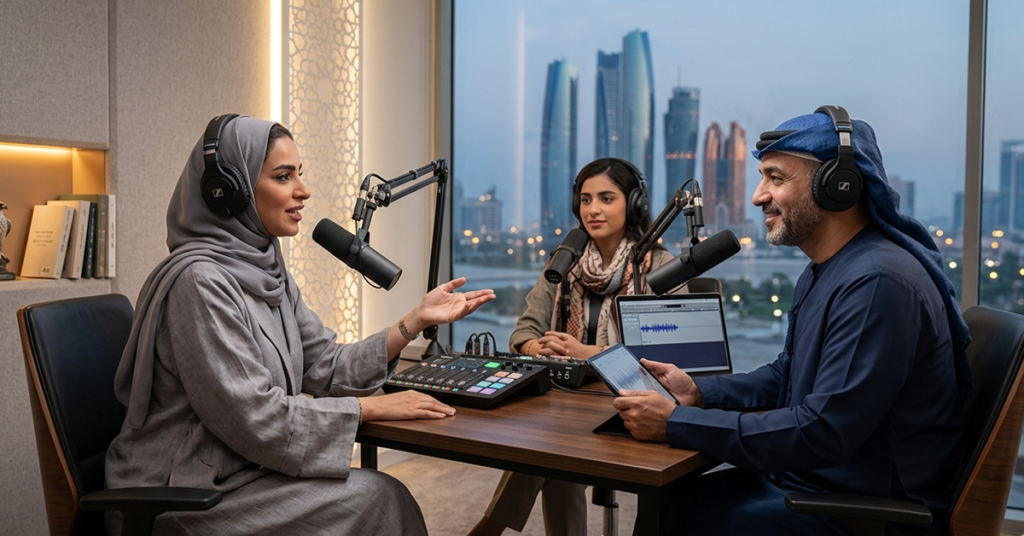
An Arabic podcast that will build a serious audience and attract commercial partnerships needs to be produced to a standard that reflects the project’s ambition. Arabic is a rich, resonant, melodically complex language. It deserves to be recorded in an environment that captures its full quality not compressed and coloured by room echo, not degraded by consumer-grade equipment, not fighting against background noise from an untreated space.
A professional recording studio provides the acoustic environment and technical equipment to make an Arabic voice sound the way the language is meant to. The difference in the final audio is not subtle it is the difference between a recording that commands respect and one that signals that the project is not quite serious yet.
Ready to launch your Arabic podcast in the UAE? Our Business Bay studio is built for exactly this broadcast-grade audio that captures the full richness of the Arabic language, 4K video for multi-platform distribution, and an on-site producer who will help you get the most out of every session. From AED 450/hr. Book your first session and start building something the UAE has been waiting for.